Serenity - 3D Method of Moments Simulation
[ Overview |
lucernhammer MT |
Serenity |
Onyx |
Galaxy |
Orion |
Lyra |
Emerald |
Sapphire ]
[ lucernhammer RCS Server |
Benchmark Data |
FAQ |
Ordering Information ]
Overview
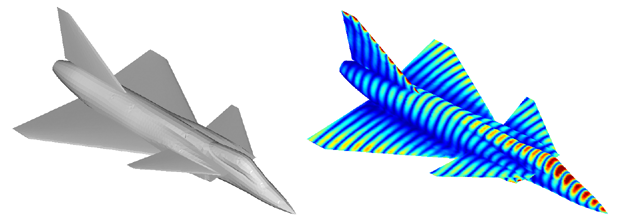
Serenity is a parallel, low-frequency (exact or full wave) radar cross section (RCS) and signature prediction code that uses
the three-dimensional Method of Moments (MoM). It is intended for treating objects of intermediate to large electrical size that asymptotic codes such as
lucernhammer MT are ill-suited to handle.
Serenity is a state of the art moment method code, which fills and factors the MoM matrix directly in compressed form using the Adapative
Cross Approximation (ACA) or Multi-Level Adaptive Cross Approximation (MLACA).
Publications
Feature Details
- Monostatic and Bistatic complex-valued scattered far field and RCS.
- Uses ACAD facet files, and uses RWG basis functions.
- Serenity uses the Adaptive Cross Approximation (ACA), which performs a direct block-LU factorization of the matrix in compressed form, and
solves multiple right-hand sides simultaneously. Memory savings and solution speed are orders of magnitude better than a direct, full matrix solver. Both single and
multi-level ACA (MLACA) are supported.
- Supports conducting (PEC) objects, as well as objects that are conducting, dielectric, or composite. Dielectrics may be lossy, and junctions between
dielectric and conducting regions are fully supported.
- Supports the impedance boundary condition (IBC) as well as resistive cards (R-Cards).
- Supports multiple run-time geometry files, allowing the user to specify separately the pieces of a composite geometry or scene.
- An ultra-high performance GPU-accelerated single and multi-level ACA solver is available for systems with NVIDIA CUDA capable GPUs.
Single and multi-GPU systems are supported.
- Highly parallelized, Serenity is available for shared memory (SMP) as well as distributed memory systems (clusters) using MPI. CPU-only clusters, or clusters where each node
is equipped with one or more NVIDIA CUDA capable GPUs, are supported.
- The ACA solver supports out-of-core (OOC) operation for use with large, fast solid state disks (SSDs).
- Serenity is a console based application, and can be easily run inside scripts and batch jobs.
lucernhammer © 2025, Tripoint Industries. All Rights Reserved